
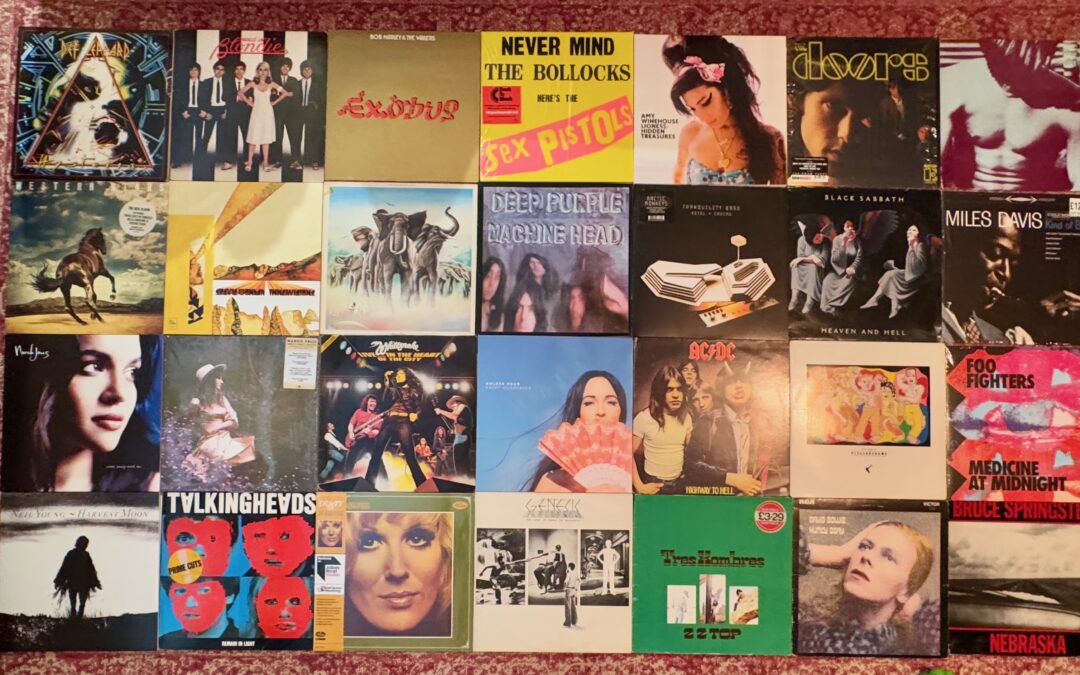
This is the third article in my series exploring how the things we love – football, motoring, and now music – have all been shaped by technology and control. Each in its own way shows how progress can polish away the rough edges that once made them feel alive.
I’ve always had a soft spot for vinyl records and a bookshelf with about 300 of them. It’s not about nostalgia, exactly, or even the sound quality. It’s the experience. Taking a record from its sleeve, placing the needle, hearing that brief crackle before the music begins. It’s imperfect, but that’s part of its charm.
Radio presenter John Peel once said that “life has surface noise.” He was right. Those little imperfections – the slight hiss, the uneven timing, the quiet moments between songs – are what make it feel real. Listening to vinyl asks you to slow down. You don’t skip tracks. You commit to the journey.
By contrast, digital music is clean, instant and flawless. You can summon any track in seconds, skip halfway through, or build the perfect playlist. Convenient, yes, but a little detached. It’s music as data, not a shared experience. The same song that once sounded different every time now plays with mathematical precision.
Character over perfection
When I wrote recently about cars, bikes and football, a pattern kept emerging. Whether it’s an over-managed match, a car that drives itself, or an algorithm choosing your next song, perfection has become the goal. Yet the pursuit of perfection often strips away character – the very thing that makes something memorable.
A record player/turntable doesn’t optimise. It doesn’t auto-adjust. It just plays. And that’s what gives it soul.
We often talk about connection in business or creativity as if it’s a metric to be engineered. But real connection isn’t engineered. It’s felt. It happens when something or someone seems genuine – unpolished, sometimes unpredictable, but undeniably human.
A rhythm worth remembering
Vinyl, for all its flaws, brings people together in ways that streaming never could. Friends gathered round a turntable, a record shop conversation, a sleeve note that still smells faintly of cardboard and ink. It’s tactile, it’s imperfect, and it stays with you.
Maybe that’s the real lesson here. Whether it’s football, riding a motorbike or the work we do every day, people are drawn to things that feel alive – not designed to eliminate every flaw. The world will keep getting smoother, faster and more connected. But the things that last, and that move us, will always have a little surface noise.
Next time, I’ll bring these threads together – from football to motoring to music – and look at what all of this says about how we live and work today.
In the meantime, here are links to the two previous blogs in this series about authenticity and emotional connection if you’d like to dip in: