

This is part one of a short series exploring whether technology and efficiency – in football, in motoring, even in music – have come at the cost of authenticity. Because in the end, authenticity matters more than control. That’s as true for the clubs we follow as it is for the cars we drive or the music we listen to.
I’ll start with football, because with the new Premier League season having just kicked off, the timing could not be better.
The Premier League is back. A new season, the same saturation coverage.
Yet for all the hype, the product on the pitch feels… different. Not necessarily worse in terms of quality – the players are fitter, faster, and more technically gifted than ever – but the drama, the unpredictability of two teams engaged in a contact sport that inspires all sorts of emotions (and probably is the ultimate brand loyalty) it feels like we’re losing some of the magic of ‘the beautiful game’?
Is revenue and tech being prioritised over emotional connection?
If the opening weekend is any guide, little has changed. Leeds’ win over Everton on Monday night was remembered less for the football than for a late VAR penalty that made the headlines. Once again, control and process took centre stage, leaving fans to argue about rules instead of the spectacle.
A decade of change
Ten years ago, football still felt gloriously messy – for want of a better word. Shocks happened more often. Long-range goals were more common. Teams took risks. Leicester’s title win in 2016 remains the ultimate fairy-tale reminder of what chaos at the top level could produce – and why it captured the imagination worldwide.
Today, though, data and analysis dominate
Clubs are businesses first, football clubs second. My own team, Brighton and Hove Albion, are admired for becoming an ‘asset creation machine’, signing relatively unknown players through smart recruitment and analysis, perfecting their skills and selling them on for huge profit. It works brilliantly as a model. But it also highlights what the game has become: less about belonging, more about balance sheets.
The curse of technology
And don’t get me started on VAR. It was meant to clear up mistakes, to inject fairness into the game. Instead it slows everything down, replaces joy with hesitation, and sparks endless arguments. It’s a perfect case study in ‘be careful what you wish for’. The truth is that technology doesn’t have the answers for everything – least of all for the unpredictability that makes football, football.
Football as business
The Premier League is now a global entertainment product. Subscribers are prioritised over fans in the ground. Sky and TNT boast about showing hundreds of live games each season. Very recently Paddy Power even ran an advert telling punters to take a break from betting, right before Sky aired another promising wall-to-wall coverage. It’s football on tap – but saturation isn’t the same as satisfaction.
The Telegraph recently argued that the Premier League’s popularity may already have peaked (Telegraph, 12 August 2025). The overload of matches, the flattening of narrative, and the predictability of outcomes risk turning what was once an emotional rollercoaster into a technical exercise.
Player loyalty – or lack of it
It’s not just the way football is packaged. On the pitch, player loyalty feels almost extinct as stars push for exits or treat clubs as mere stepping stones. Once upon a time, fans may have hoped that players would show loyalty and stick around, even through hard times. Now, the hard times rarely come for the top clubs – and when they do, players are quick to move on.
The chart that tells the story
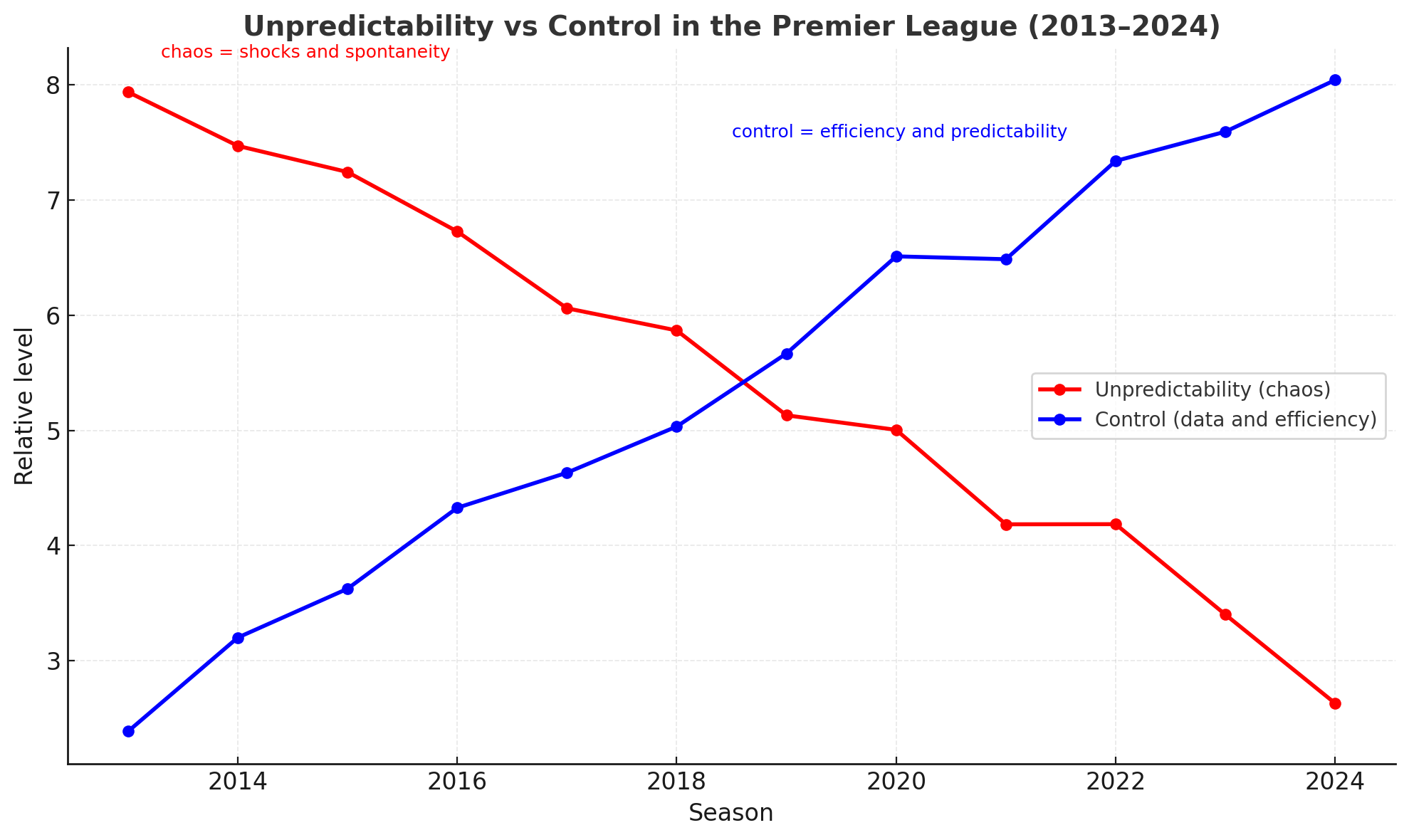
I’ve had some dialogue with AI in order to come up with a simple diagram that might help make my point; over the past decade, the Premier League has moved steadily away from unpredictability and towards control. Yes, I’m aware that I am using data in order to make a point grumbling about data…
Explanation for the chart
Unpredictability – measured through shocks, upsets and wider goal margins – has steadily declined.
Control – in the form of tighter scorelines, tactical systems, data-driven recruitment and interventions like VAR – has grown.
Put simply: the Premier League is more efficient, but less thrilling.
Refereeing clampdowns
Next is the endless diving, time-wasting and tactical fouling, and it sometimes feels like the match itself is secondary to the machinery around it. Even refereeing is being micro-managed into submission.
This season, officials have been told to crack down on “dark arts” such as simulation, holding at set pieces and delaying play (Telegraph, 14 August 2025). In theory, it’s welcome – who doesn’t want fewer cheats? – but in practice it risks sanitising the spectacle. Every incident becomes a flashpoint, another excuse for the system to intrude. Whether this restores the flow of the game or simply adds yet another layer of control remains to be seen.
Looking beyond the top tier
Perhaps this is why I find myself drawn towards lower-league and non-league football this season. On the occasions I’ve gone with my son, we both loved the rawness and unpredictability. No VAR, more passion and a stronger sense of local belonging not business. – it reminded me of why I like watching the game in the first place.
Conclusion
Football was never meant to be perfect – it was meant to make us feel. What we miss isn’t precision or polish, but the unpredictability and sense of belonging that once made the game so popular. Maybe that’s why more of us are being drawn back to lower league grounds, muddy pitches and raw atmospheres, where football still feels like it belongs to the people in the stands.
Strip away the gloss, and I think what we crave is authenticity – and that’s something the Premier League risks losing, no matter how many cameras, stats or VAR checks are added to the mix.
Trackbacks/Pingbacks